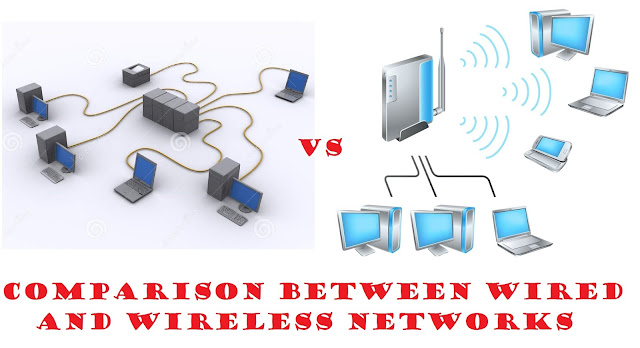
Comparison Between Wired network & Wireless Network
wired Network
In computing terminology, the term "wired" is used to differentiate between wireless connections and those that involve cables. A wired setup uses physical cables to transfer data between different devices and computer systems. The cables can be copper wire, twisted pair or fiber optic. Wired network is used to carry different forms of electrical signals from one end to the other. Most wired networks use Ethernet cables to transfer data between connected PCs. Ethernet works or operates in a narrow range and it is little bit difficult to configure as compared to wireless networking technologies.
Wireless Network
wireless network refers to the use of infrared or radio frequency signals to share information and resources between devices. Wireless technologies are designed to reduce the time and different type of obstacles created by the cables. Wireless network does not use wires for data or voice communication; it uses radio frequency waves as mentioned above. Many types of wireless devices are available today;for example, cellular mobile, handheld PCs, satellite receivers, laptop, PDAs, wireless sensors etc.
 |
COMPARISON BETWEEN WIRED NETWORK AND WIRELESS NETWORK
Below table mention comparison between wired network and wireless network:-
Sr. No
|
Parameters
|
Wired Network
|
Wireless Network
|
1
|
Installation
|
Difficult (Because more no’s of
compound are used during installation and required no’s of cables for
connecting each and every computers)
|
Easy installation
|
2
|
Speed and Bandwidth
|
High (up to 100mbps)
|
Low (up to 54mbps)
|
3
|
Reliability
|
High(Due to existence of wired
technology and as manufactured cable have higher performance)
|
Reasonably high( because if the major
section like router break down the whole network will be affected)
|
4
|
Cables
|
Ethernet, copper and optical fibers
|
Works on radio waves and microwaves
|
5
|
Mobility
|
Limited, as it operates in the area
covered by connected systems with the wired network
|
Not limited, as it operates in the
entire wireless network coverage
|
6
|
Security
|
Good
|
Weak
|
7
|
Interference
|
Less (Networks are invisible to other
wired networks. The presence of one wired network has no effect on the
performance of another wired network)
|
Higher (the potential for radio
interference due to weather, other wireless devices, or obstructions like
walls)
|
8
|
Quality of Service
|
Better
|
Poor
|
9
|
Connection setup time
|
Less
|
More
|
10
|
Devices used
|
Hubs and Switches
|
Routers
|
11
|
Cost
|
Less as cables are not expensive
|
More as wireless subscriber stations,
wireless routers, wireless access points and adapters are expensive
|
12
|
Applications
|
LAN (Ethernet),
MAN
|
WLAN,
WPAN(Zigbee, bluetooth), Infrared, Cellular(GSM,CDMA, LTE)
|
13
|
Standards
|
IEEE802.3
|
IEEE802.11a, IEEE 802.11b ,
IEEE802.11g
|